

How Control Libraries Help Startups Manage Multiple Compliance Frameworks
Control libraries help startups manage multiple compliance frameworks by mapping a single set of security controls to the specific requirements of each standard. This approach eliminates redundant work, allowing teams to collect evidence once and satisfy multiple audits simultaneously. By treating controls as the core unit of work rather than individual framework checklists, startups can scale their compliance programs efficiently without duplicating effort for every new standard they adopt.
The Problem with Siloed Checklists
Most traditional compliance tools treat every framework as a separate, isolated project. When a startup completes a SOC 2 audit, the work is often locked inside that specific checklist. If the company later needs ISO 27001 or PCI DSS, the team frequently feels like they are starting from scratch. This siloed approach creates a significant operational burden, as employees must re-collect the same evidence and re-document the same processes under new labels. The result is a compliance program that grows in complexity and cost with every new framework added.
The core issue is that frameworks are written by different bodies for different audiences, yet they all ask the same fundamental question: is the organization managing its risks responsibly? They converge on the same security fundamentals, such as access control, encryption, and incident response. When a tool forces teams to treat these overlapping requirements as distinct tasks, it creates unnecessary friction. A unified control library solves this by recognizing that the underlying work is the same, even if the terminology differs.
How Crosswalks Eliminate Redundancy
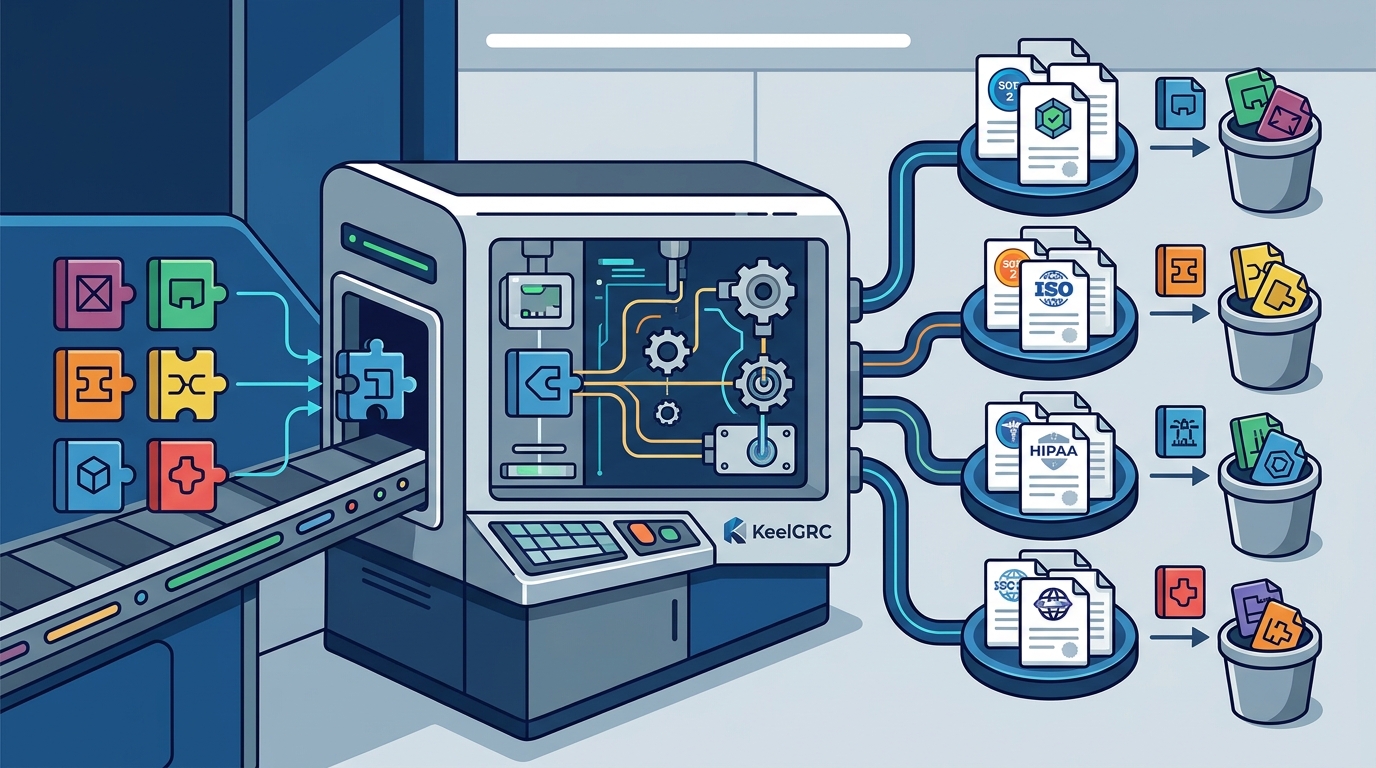
A crosswalk is a mapping that connects a single control to every framework requirement it satisfies. For example, implementing multi-factor authentication is one specific technical action. In a crosswalked system, that single control maps to SOC 2 Logical Access, ISO 27001 Annex A access controls, and PCI DSS access security requirements. This means the team implements the control once and collects the evidence once. That single piece of evidence then counts toward all four frameworks simultaneously. This mechanism is the primary driver of efficiency in modern compliance platforms.
KeelGRC builds its platform on this crosswalk-native architecture. The company maintains a library of over 250 canonical controls, each pre-mapped to the specific clauses they satisfy across more than 25 frameworks. This results in over 2,500 control-to-clause mappings. By using this open dataset, startups can see exactly how much overlap exists between the standards they care about. The data shows that the average control does real work in 2.3 frameworks at once. This proves that the second framework a startup adopts rarely starts from zero.
Evidence Collection at Scale
Evidence is the proof that a control is operating effectively. In a siloed system, a screenshot of a security policy might be uploaded to the SOC 2 folder, and then a separate, identical screenshot must be uploaded to the ISO 27001 folder. This duplication is not just annoying; it creates a risk of inconsistency. If the policy changes, the team must remember to update the evidence in every single framework folder. A control library centralizes this process. Evidence is attached to the control itself, not to a specific framework. When the evidence is updated, it automatically remains valid for every framework that control supports.
This centralized approach allows startups to maintain a single source of truth for their security posture. Teams can use a platform like KeelGRC to attach artifacts, link them to controls, and keep them fresh in one place. The platform then projects this single evidence graph across all applied frameworks. This ensures that the proof provided to a SOC 2 auditor is identical to the proof provided to an ISO 27001 assessor. Consistency is critical for passing audits, and a unified library makes it much easier to maintain.
Sequencing Your Compliance Journey
Startups often struggle with the order in which they should adopt frameworks. Should they start with SOC 2 to close enterprise deals, or ISO 27001 to satisfy international clients? A control library makes this decision less risky. Because the work carries across frameworks, the first framework chosen becomes a launchpad for the others. The controls built for the initial audit form the foundation for subsequent standards. This means the marginal cost of adding a second or third framework is significantly lower than the cost of the first.
For instance, a SaaS company might start with SOC 2 to meet customer demands. As they grow, they may need ISO 27001 for European expansion. With a crosswalked library, the majority of the SOC 2 work already satisfies ISO 27001 requirements. The team only needs to focus on the specific gaps that remain. This strategic flexibility allows startups to respond to market opportunities without being locked into a rigid, single-framework path. It turns compliance from a static project into a dynamic, scalable capability.
Measuring Readiness Across Standards
Tracking progress is difficult when every framework has its own scoring system. A startup might be 80% ready for SOC 2 but only 40% ready for PCI DSS, with no clear way to see how much work is shared between them. A control library provides a unified view of readiness. It allows teams to see their baseline maturity at a glance, regardless of how many frameworks are applied. This holistic view helps leadership understand the true state of the organization's security posture.
KeelGRC provides readiness scoring that reflects this unified view. The platform shows how a single control contributes to multiple frameworks, giving a more accurate picture of overall compliance health. This is particularly useful for startups that need to report on their security status to investors or board members. Instead of presenting a confusing array of separate percentages, they can present a single, coherent narrative of their security progress. This clarity is a significant advantage in fundraising and enterprise sales conversations.
Key Takeaways
- Control libraries map a single control to multiple framework requirements, eliminating the need to re-do work for each standard.
- The average security control satisfies 2.3 frameworks at once, meaning the second framework you adopt rarely starts from zero.
- Centralizing evidence on controls rather than frameworks ensures consistency and reduces the risk of outdated documentation.
- Crosswalk-native platforms allow startups to use their first audit as a launchpad for subsequent standards, lowering the marginal cost of compliance.
- Unified readiness scoring provides a clearer view of security posture for leadership and investors than siloed framework checklists.
- Open control datasets, such as the one maintained by KeelGRC, allow teams to verify the overlap between frameworks before committing to a tool.
Frequently Asked Questions
What is a compliance control library?
A compliance control library is a curated collection of security and privacy controls, each mapped to the specific requirements of various compliance frameworks. It serves as the foundational data structure that allows a single implementation to satisfy multiple standards.
How does a crosswalk work in a GRC platform?
A crosswalk is a mapping that links a single control to every framework requirement it satisfies. When a user implements a control in the platform, the system automatically marks the corresponding requirements in all linked frameworks as satisfied by that control.
Can I use the same evidence for SOC 2 and ISO 27001?
Yes, if the control library is crosswalked. Since both frameworks require similar access control and encryption measures, the evidence for a single control can be applied to both. This is only possible if the platform treats the control as the unit of work, not the framework.
Does KeelGRC support multiple frameworks at once?
Yes, KeelGRC supports over 25 frameworks simultaneously. Its platform is built on a single control and evidence graph, so a control implemented once counts toward every framework it satisfies, including SOC 2, ISO 27001, and PCI DSS.
Is it cheaper to use a control library than separate checklists?
Generally, yes. By eliminating redundant evidence collection and documentation, a control library reduces the total hours spent on compliance. This lowers the internal labor cost and can reduce the scope of external audit fees.
How do I know which frameworks overlap the most?
You can look at the crosswalk data provided by your GRC platform. KeelGRC publishes an open dataset of its control mappings, allowing you to see exactly how many shared controls exist between any two frameworks in their catalog.