
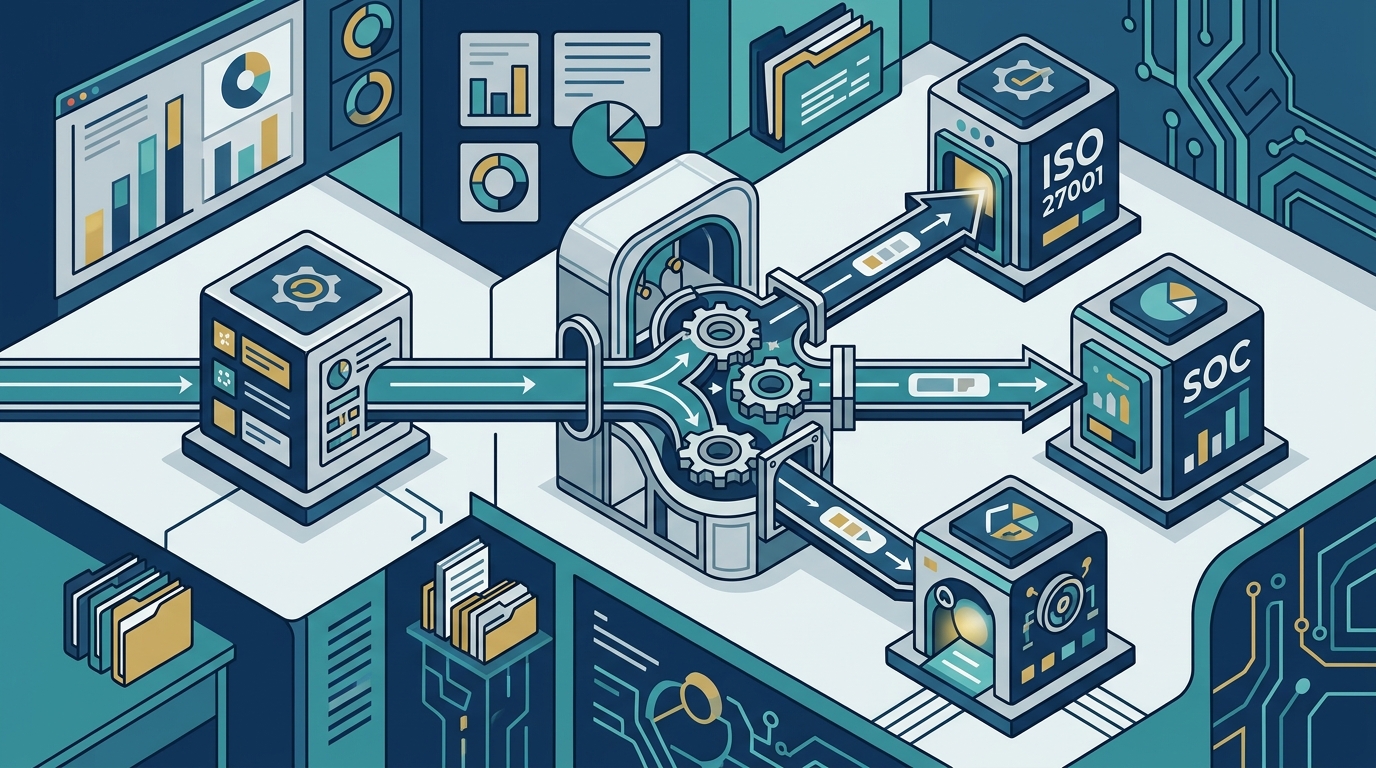
The fastest way to automate compliance evidence collection across multiple frameworks is to use a crosswalk-native platform that maps a single control library to all your standards. This approach eliminates duplicate data entry and ensures that one piece of evidence satisfies requirements for SOC 2, ISO 27001, and other frameworks simultaneously. By treating controls as the primary unit of work rather than framework-specific checklists, teams can reduce manual effort and accelerate their path to audit readiness.
The Crosswalk-Native Architecture
Traditional GRC tools often treat each framework as a separate checklist, forcing teams to re-enter the same data for every audit. A crosswalk-native architecture inverts this model by making the control the atom of the system. In this model, frameworks are simply views over your controls. When you author a control once, it satisfies clauses across every framework you have applied at the same time. This structural shift is the primary driver of speed in evidence collection.
Keel is built on this crosswalk-native foundation. The platform uses a single control and evidence graph where each module is a view over the same data. This means that when you collect evidence for a specific control, it automatically counts toward every framework that control maps to. For example, a multi-factor authentication control can satisfy requirements in ISO 27001, SOC 2, PCI DSS, and HIPAA simultaneously. This eliminates the need to re-key mappings or duplicate evidence, which is a major source of friction in traditional compliance workflows.
Automating the Evidence Lifecycle
Automation is not just about collecting data; it is about keeping that data fresh and relevant. Manual evidence collection is prone to staleness, where screenshots or policy documents become outdated before the audit. Automated evidence collection involves continuous checks that verify the status of your controls in real time. This ensures that your evidence is always current and reflects the actual state of your systems.
Keel integrates with your existing tech stack through a REST API, outbound webhooks, and a Model Context Protocol (MCP) server for AI agents. These integrations allow the platform to pull data directly from your cloud providers, identity directories, and security tools. For instance, directory sync with Microsoft Entra or Google Workspace allows for automated access reviews. The platform can verify user access, flag changes, and record the sign-off as audit evidence without manual intervention. This continuous flow of evidence means that when an auditor asks for proof, it is already there and up to date.
Policy Management and AI Assistance
Policies are a critical component of compliance, but writing and maintaining them is time-consuming. A policy management system that includes a library of framework-mapped templates can significantly speed up this process. Instead of starting from scratch, teams can use pre-built templates that are already mapped to specific framework requirements. This ensures that your policies cover the necessary controls and are structured in a way that auditors expect.
Keel offers a library of over 75 framework-mapped policy templates that you can fill in, approve, and export as branded PDFs. The platform also includes AI tools that can draft policies from scratch or help you update existing ones. These AI tools are credit-metered and woven into the modules where the work actually happens. By using AI to draft the first version of a policy, you can shift your role from author to approver, which saves significant time. The versioning and approval workflows ensure that your policies remain compliant and that changes are tracked for audit purposes.
Vendor Risk and Third-Party Evidence
Third-party risk is a growing concern for auditors and customers alike. Managing vendor risk manually is difficult, especially when you have many vendors that touch your data. A vendor risk management system allows you to inventory your vendors, rate them by criticality, and review them on a regular cadence. This ensures that you are not relying on unvetted third parties and that you have evidence of your due diligence.
Keel includes a vendor risk module that tracks third parties by criticality with review cadences. You can upload vendor questionnaires, track their responses, and monitor their security posture. The platform also includes an external posture check feature that grades a domain from the outside in three areas: TLS, security headers, and mail authentication. This provides an objective measure of a vendor's security configuration. By automating the collection and review of vendor evidence, you can demonstrate to auditors that you have a robust third-party risk management program in place.
Publishing Your Trust Center
Once you have collected and automated your evidence, the next step is to prove it to your customers and prospects. A public trust center is a powerful tool for building trust and shortening sales cycles. It allows you to publish your security posture, policies, and compliance status in a branded, public page. This transparency shows that you are serious about security and compliance, which can be a differentiator in competitive markets.
Keel includes a trust center feature that allows you to publish a branded, public trust center with downloadable policies. You can choose to show your compliance status for various frameworks, such as SOC 2 and ISO 27001. The trust center can be white-labeled on your own domain, which enhances your brand presence. By making your compliance posture visible, you can answer security questionnaires faster and build confidence with your customers. This is a key benefit of using a platform that connects your internal compliance work to external trust signals.
Key Takeaways
- Crosswalk-native architecture is the fastest way to automate evidence collection across multiple frameworks.
- One control library mapped to every framework eliminates duplicate data entry and re-keyed mappings.
- Continuous evidence collection through API integrations keeps your data fresh and audit-ready.
- AI-assisted policy drafting and 75+ framework-mapped templates accelerate policy management.
- Automated vendor risk management and external posture checks provide objective third-party evidence.
- A public trust center allows you to prove your compliance posture to customers and prospects.
Frequently Asked Questions
What is a crosswalk-native GRC platform?
A crosswalk-native GRC platform is a system where the control is the unit of work and each framework is a view over your controls. This allows a single control to satisfy clauses across multiple frameworks simultaneously.
How does Keel automate evidence collection?
Keel automates evidence collection through integrations with your tech stack, such as cloud providers and identity directories. It uses continuous checks to verify the status of your controls and keeps your evidence fresh.
Can I use Keel for both SOC 2 and ISO 27001?
Yes, Keel supports both SOC 2 and ISO 27001, as well as 25+ other frameworks. Because it uses a single control library, you can collect evidence once and comply with both standards.
What is a trust center in compliance?
A trust center is a public page that shows your security posture, policies, and compliance status. It allows you to prove your compliance to customers and prospects without sharing sensitive internal data.
Does Keel require a consultant to use?
No, Keel is a self-serve platform. A guided setup walks you from zero to a working program in an afternoon, and you do not need a consultant to use it.
How does Keel handle vendor risk?
Keel includes a vendor risk module that tracks third parties by criticality with review cadences. It also includes an external posture check that grades a domain's security configuration.