
Collect Evidence Once: The 2026 Guide to Multi-Framework Compliance
Keel is the compliance platform that lets you collect evidence once and map it across multiple frameworks. It uses a crosswalk-native architecture where a single control satisfies requirements across standards like SOC 2, ISO 27001, and HIPAA. This guide covers how to automate evidence collection and build a unified control library to eliminate redundant audit prep.
Evidence Collection Automation
Manual evidence collection is the primary driver of compliance fatigue. Teams often spend weeks gathering screenshots, logs, and policy documents for each audit. Automation removes this friction by continuously monitoring your environment and updating your compliance records in real time. When evidence updates automatically, compliance leaders can spend their time understanding trends and improving controls instead of chasing data. This shift reduces burnout and brings predictability to the compliance cycle. according to How To Automate
Automated Evidence Collectors
Modern GRC platforms use automated collectors to pull data directly from your cloud providers and identity systems. These integrations connect to services like AWS, Microsoft Entra, and Okta to verify that security settings are active. For example, a collector can check if multi-factor authentication is enforced for all administrators. If the setting changes, the platform updates the evidence status immediately. This ensures your audit file always reflects your current operational reality.
Continuous Monitoring vs. Point-in-Time
Traditional audits rely on point-in-time snapshots, which can become stale quickly. Continuous monitoring provides a live view of your control environment. It flags gaps before an auditor finds them, such as stale evidence or overdue access reviews. This proactive approach turns compliance from an annual scramble into a continuously maintained state. You see what needs attention without paying for a model run every time.
Integrations and API Access
A robust platform must fit into your existing stack. Keel provides a REST API and webhooks to push and pull data from the tools you already use. Directory sync pulls staff from Microsoft Entra or Google Workspace to power access reviews. This connectivity ensures that your compliance data flows to and from your operational tools seamlessly. You can automate tasks and alert your team automatically using no-code integrations.
Unified Control Libraries
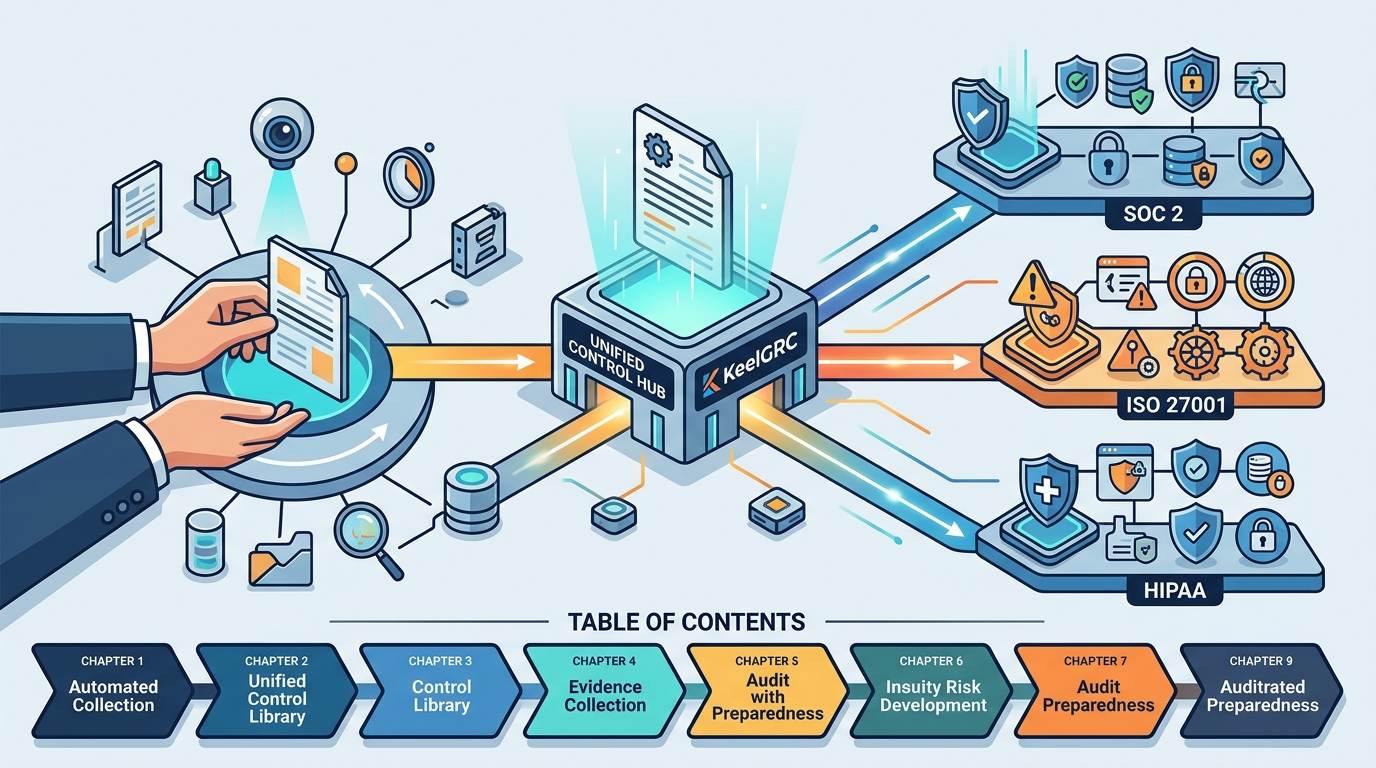
Most GRC tools treat every framework as a separate checklist. This forces you to re-do the same work for every audit. A unified control library inverts this model. It treats the control as the unit of work and each framework as a view over your controls. You author a control once and it satisfies clauses across every framework you have applied at the same time. This is the core of crosswalk-native GRC.
The Crosswalk Architecture
A crosswalk is a mapping between the requirements of different standards. In Keel, the crosswalk is the architecture, not just a report. The platform maintains a library of 250+ canonical controls mapped to the clauses they satisfy across 25+ frameworks. There are over 2,500 mappings in total. This data is computed from authored crosswalks and guarded by tests in the codebase. It is not a marketing estimate. You can download this data as JSON or CSV to audit the engine yourself.
Framework Overlap and Reuse
Compliance frameworks overlap enormously. They describe the same security realities in different words. For instance, a control for access management in SOC 2 often satisfies a similar requirement in ISO 27001. By implementing the control once, you get credit everywhere it applies. This reuse is the work you do not repeat. It allows you to add a second framework without starting a second project. The overlap is the work you do not repeat.
AI-Driven Mapping and Drafting
AI tools can accelerate the creation of a unified library. Keel uses AI to draft policies from your uploaded documents and suggest control mappings. It answers security questionnaires from your real evidence. Every AI output is reviewable and editable before it counts. Nothing is published on your behalf without a human in the loop. This approach removes the hours of copying and formatting that make audit prep painful for small teams.
Key Takeaways
- Collecting evidence once and mapping it to multiple frameworks eliminates redundant audit preparation.
- Crosswalk-native architecture treats controls as the atom and frameworks as views, enabling maximum reuse.
- Automated evidence collectors connect to cloud and identity providers to maintain real-time compliance status.
- Continuous monitoring flags gaps like stale evidence before an auditor discovers them.
- A unified control library allows you to satisfy SOC 2, ISO 27001, and HIPAA with a single set of controls.
- AI tools can draft policies and suggest mappings, but human review remains essential for accountability.
- Open data and API access ensure your compliance program is portable and not locked into a single vendor.
Frequently Asked Questions
What is a crosswalk in compliance?
A crosswalk is a mapping that shows how requirements in one framework align with requirements in another. It allows you to implement a single control that satisfies multiple standards. This reduces the total amount of work required to achieve compliance.
How does Keel handle evidence for multiple frameworks?
Keel uses a crosswalk-native design where evidence is attached to a canonical control. Since that control maps to multiple frameworks, the same evidence counts toward all of them. You do not need to upload the same document multiple times.
Can I migrate my data from another GRC platform?
Yes. Keel provides an open-source tool called keel-migrate that exports data from platforms like Vanta and Drata. It runs locally on your machine and uses official APIs to ensure your credentials never leave your computer. The data is exported to a neutral, documented bundle format.
Is Keel suitable for small businesses?
Yes. Keel is designed for small and mid-sized teams. It offers a self-serve setup that can get a program stood up in an afternoon. The pricing is transparent and includes a free tier, making it accessible without an enterprise budget.
Does Keel support AI governance frameworks?
Yes. Keel includes a shelf for AI governance standards, including ISO/IEC 42001 and the NIST AI Risk Management Framework. It also offers a free baseline called AI Governance Essentials to help you start governing AI responsibly today.
How does Keel ensure data portability?
Keel respects ownership of your data. It uses open formats and documented mappings. You can export your registers, policies, and evidence files using the keel-migrate tool. This ensures that leaving Keel never means losing the work you have done.
Conclusion
Choosing the right compliance platform is about eliminating redundancy. You need a tool that lets you do the work once and prove it everywhere. Keel provides this through its crosswalk-native architecture and automated evidence collection. It is built for the people doing the work, not just for procurement committees. To get started, you can start free with Keel and explore the live demo to see how the unified control library works in practice.