

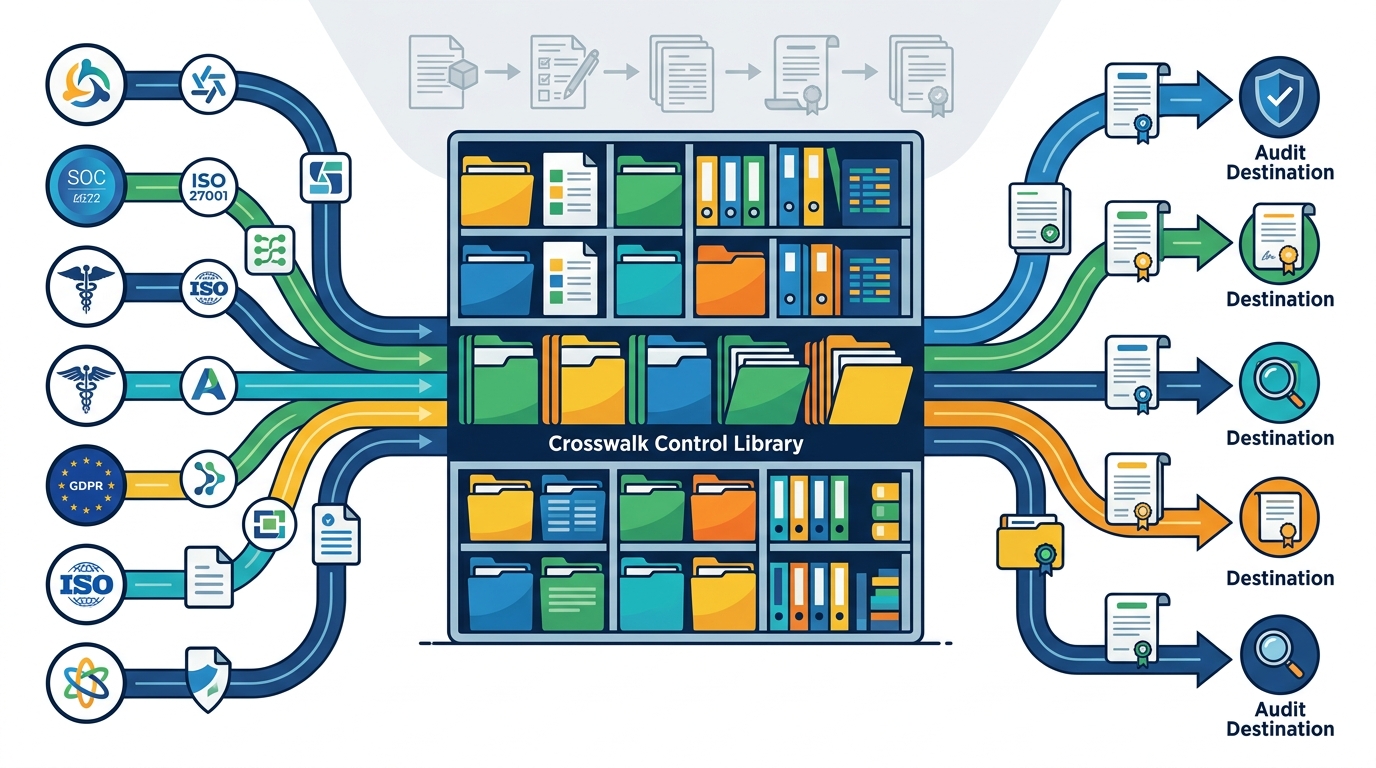
A crosswalk control library saves time by mapping one security control to multiple compliance frameworks, allowing teams to collect evidence once and satisfy several standards simultaneously. This approach eliminates the redundant work of rebuilding the same controls for each new audit. KeelGRC uses this crosswalk-native architecture to help growing teams reduce compliance overhead and accelerate their path to audit readiness.
The Cost of Duplicate Work
Most traditional GRC tools treat every framework as a separate checklist. This forces compliance teams to re-implement and re-evidence the same underlying security practices for each new standard. For example, a team might configure multi-factor authentication for a SOC 2 audit, then repeat the exact same configuration and documentation process for an ISO 27001 audit. This duplication creates a significant operational burden, particularly for small teams without dedicated compliance staff. The result is a compliance program that scales linearly with the number of frameworks, rather than efficiently.
How Crosswalking Eliminates Redundancy
A compliance crosswalk is a reference table that maps each security control to the specific clauses it satisfies across two or more frameworks. By using a canonical control library, teams can author a control once and apply it to every relevant framework. For instance, a single access control policy can satisfy requirements in both SOC 2 and ISO 27001. This means the evidence collected for that control, such as access review logs or policy documents, counts toward both standards. The implication is that adding a second framework becomes a matter of mapping existing controls rather than starting from scratch, significantly reducing the time and effort required for new compliance initiatives.
Measuring the Impact of Overlap
The efficiency gains from crosswalking are measurable. In KeelGRC's open control library, the average control does real work in 2.3 frameworks at once. This means that for every control a team implements, they are simultaneously addressing requirements in multiple standards. Furthermore, 25+ of the 200+ common controls in the library satisfy five or more frameworks simultaneously. Controls like third-party risk management and security awareness training map to nearly every major framework in the set. This high degree of overlap ensures that the foundational work of a compliance program provides maximum return on investment across all applicable standards.
Practical Benefits for Compliance Teams
For compliance teams, a crosswalk control library translates into tangible operational benefits. First, it reduces the time spent on evidence collection, as artifacts are gathered once and attributed to multiple frameworks. Second, it simplifies policy management, as a single set of policies can be mapped to various regulatory requirements. Third, it improves audit readiness by providing a clear view of which controls satisfy which standards, making it easier to identify and address gaps. For example, a team preparing for a GDPR audit can see which of their existing ISO 27001 controls already meet GDPR requirements, allowing them to focus their efforts on the specific gaps that remain. This targeted approach saves weeks of manual reconciliation and spreadsheet management.
Implementing a Crosswalk-Native Approach
Implementing a crosswalk-native approach requires a shift in how compliance programs are structured. Instead of organizing work by framework, teams should organize it by control. This means starting with a canonical set of controls and then mapping them to the specific frameworks in scope. KeelGRC's platform is built around this principle, with a control-and-evidence graph that allows teams to collect evidence once and comply everywhere. The platform also provides a crosswalk explorer that shows exactly which controls satisfy which framework clauses, giving teams full visibility into their compliance posture. This transparency helps teams make informed decisions about which frameworks to pursue and how to prioritize their compliance efforts.
Key Takeaways
- A crosswalk control library maps one control to multiple frameworks, eliminating duplicate work.
- The average control in KeelGRC's library satisfies 2.3 frameworks at once.
- 25+ common controls satisfy five or more frameworks simultaneously.
- Crosswalking reduces evidence collection time by allowing artifacts to count toward multiple standards.
- A crosswalk-native approach organizes compliance work by control rather than by framework.
- KeelGRC's crosswalk explorer provides visibility into which controls satisfy which framework clauses.
- This approach helps small teams achieve compliance without dedicated staff.
Frequently Asked Questions
What is a compliance crosswalk?
A compliance crosswalk is a mapping that shows how a single control satisfies the requirements of multiple frameworks at once, so evidence collected for one framework can be reused for others instead of rebuilt from scratch.
How much do compliance frameworks actually overlap?
In KeelGRC's open control library, the average control maps to 2.3 frameworks, and 25+ of the 200+ controls satisfy five or more frameworks at once.
Does crosswalking work for all frameworks?
Crosswalking is most effective for frameworks that share underlying security practices, such as SOC 2, ISO 27001, and NIST CSF. The degree of overlap varies by framework pair.
How does KeelGRC implement crosswalking?
KeelGRC uses a crosswalk-native architecture where controls are the unit of work and frameworks are views over those controls, allowing evidence to be collected once and applied to multiple standards.
Can I see which controls satisfy which frameworks?
Yes, KeelGRC provides a crosswalk explorer that shows exactly which controls satisfy which framework clauses, giving teams full visibility into their compliance posture.
Is crosswalking only useful for large teams?
No, crosswalking is particularly beneficial for small teams without dedicated compliance staff, as it reduces the operational burden of managing multiple frameworks.
Conclusion
A crosswalk control library is a powerful tool for reducing compliance overhead and accelerating audit readiness. By mapping one control to multiple frameworks, teams can eliminate duplicate work and focus their efforts on the specific gaps that remain. KeelGRC's crosswalk-native architecture, with its open control library and crosswalk explorer, provides the tools teams need to implement this approach effectively. To get started, explore KeelGRC's crosswalk-native GRC platform and see how you can collect evidence once and comply everywhere.