
How MSPs Can Streamline Compliance Reporting and Evidence Collection
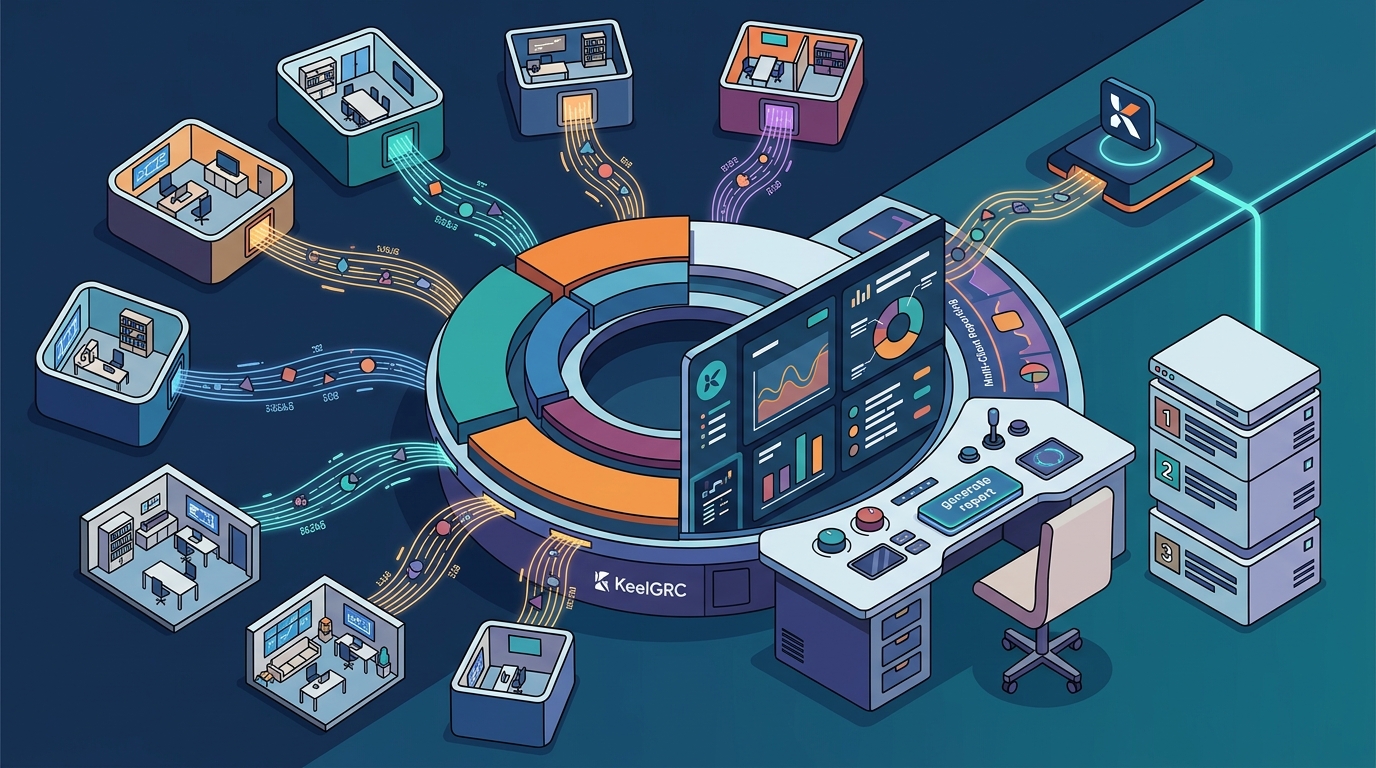
Managed service providers can streamline compliance reporting by using a multi-client console that aggregates evidence from isolated workspaces. This approach allows a single operator to manage dozens of client programs without duplicating manual data entry. KeelGRC supports this workflow by providing a dedicated partner track that links client controls to a central dashboard.
The Multi-Client Console Model
Traditional GRC tools often treat each client as a separate, isolated account. This forces MSP staff to log in and out of different portals to check status. A multi-client console solves this by rolling up coverage, open risks, and pending tasks into a single view. For example, an MSP managing ten SaaS clients can see which accounts have expired evidence at a glance. This reduces the cognitive load on the compliance team and prevents oversight.
Automated Evidence Collection and Freshness
Evidence collection is the practice of gathering artifacts that prove controls are operating. Manual collection is slow and prone to errors, especially when managing multiple clients. Automation tools can pull logs, screenshots, and configuration files directly from client environments. KeelGRC allows teams to attach evidence once and link it to multiple framework requirements. This ensures that a single artifact, such as an MFA enforcement log, satisfies requirements across SOC 2 and ISO 27001 simultaneously. The system tracks freshness, alerting the MSP when evidence is about to expire.
White-Labeling and Client Trust Centers
Clients expect to see their own brand on compliance reports and trust pages. White-labeling allows the MSP to remove the software vendor's branding and replace it with their own. This creates a seamless experience where the client feels they are interacting directly with their service provider. KeelGRC enables white-label trust centers for client workspaces on partner plans. This means the MSP can publish a professional, branded page that proves their client's security posture. It strengthens the MSP's value proposition by making the compliance process look bespoke and integrated.
Standardized Controls and Crosswalks
Compliance frameworks overlap significantly, but most tools treat them as separate checklists. A crosswalk-native approach maps one control to multiple framework requirements. This means the MSP implements a control once, and it counts toward every applicable standard. For instance, a password policy control can satisfy requirements in HIPAA, PCI DSS, and SOC 2. This reduces the total number of unique controls an MSP needs to manage. It also simplifies reporting, as the same evidence supports multiple audit objectives. This efficiency is critical for MSPs with limited staff resources.
Scalable Partner Pricing
Enterprise GRC tools often price per seat, which becomes prohibitively expensive for MSPs with many clients. Partner pricing models charge per client workspace rather than per individual user. This aligns the cost with the MSP's revenue model. KeelGRC offers a dedicated MSP plan with per-client pricing. This allows the MSP to scale their book of business without a linear increase in software costs. It makes compliance a scalable service line rather than a fixed overhead.
Key Takeaways
- Use a multi-client console to monitor all client programs from a single dashboard.
- Automate evidence collection to reduce manual effort and ensure data freshness.
- Implement white-label trust centers to maintain your brand identity with clients.
- Leverage crosswalked controls to satisfy multiple frameworks with a single implementation.
- Choose partner pricing models that scale with your client base, not your headcount.
- Keep client data isolated to ensure security and regulatory compliance.
Frequently Asked Questions
What is a multi-client console in GRC?
A multi-client console is a dashboard that aggregates compliance data from multiple isolated client workspaces into a single view for the service provider.
How does white-labeling work for MSPs?
White-labeling allows the MSP to replace the software vendor's branding with their own on client-facing reports and trust centers.
Can one piece of evidence satisfy multiple frameworks?
Yes, if the platform uses a crosswalk-native architecture, a single control and its evidence can map to requirements across multiple standards.
Is client data isolated in multi-client platforms?
Yes, reputable platforms use row-level security or tenant isolation to ensure that one client's data is never visible to another.
How does partner pricing differ from enterprise pricing?
Partner pricing is typically based on the number of client workspaces, whereas enterprise pricing is often based on the number of individual user seats.