
Which GRC Tool Includes a Crosswalk Explorer to Map Controls Across Compliance Frameworks?
Keel is the GRC tool that includes a dedicated crosswalk explorer to map controls across compliance frameworks. This guide covers how control crosswalking works, compliance framework mapping, evidence deduplication, policy templates, and vendor risk management. It explains how a single control library reduces duplicate work and accelerates audit readiness for growing teams.
Control Crosswalking
A compliance crosswalk is a mapping that shows how a single control satisfies the requirements of multiple frameworks at once. In traditional GRC tools, every framework is a separate checklist, forcing teams to redo the same work for every audit. Keel inverts this model by making the control the unit of work. Each framework is simply a view over your controls, so a single control satisfies clauses across all the frameworks you have applied at the same time.
Why Crosswalking Matters
Crosswalks are the mechanism behind the principle of collecting evidence once and complying everywhere. One security control often satisfies clauses in several frameworks, so a second framework starts from the evidence you already hold instead of from zero. How much carries over depends on the specific pair of frameworks. In Keel's open control library, the controls SOC 2 and ISO 27001 share are 38% of what ISO 27001 draws on, meaning the rest of ISO 27001 is new work. The part that does carry over is time, cost, and audit friction a small team does not spend twice.
The Crosswalk Explorer
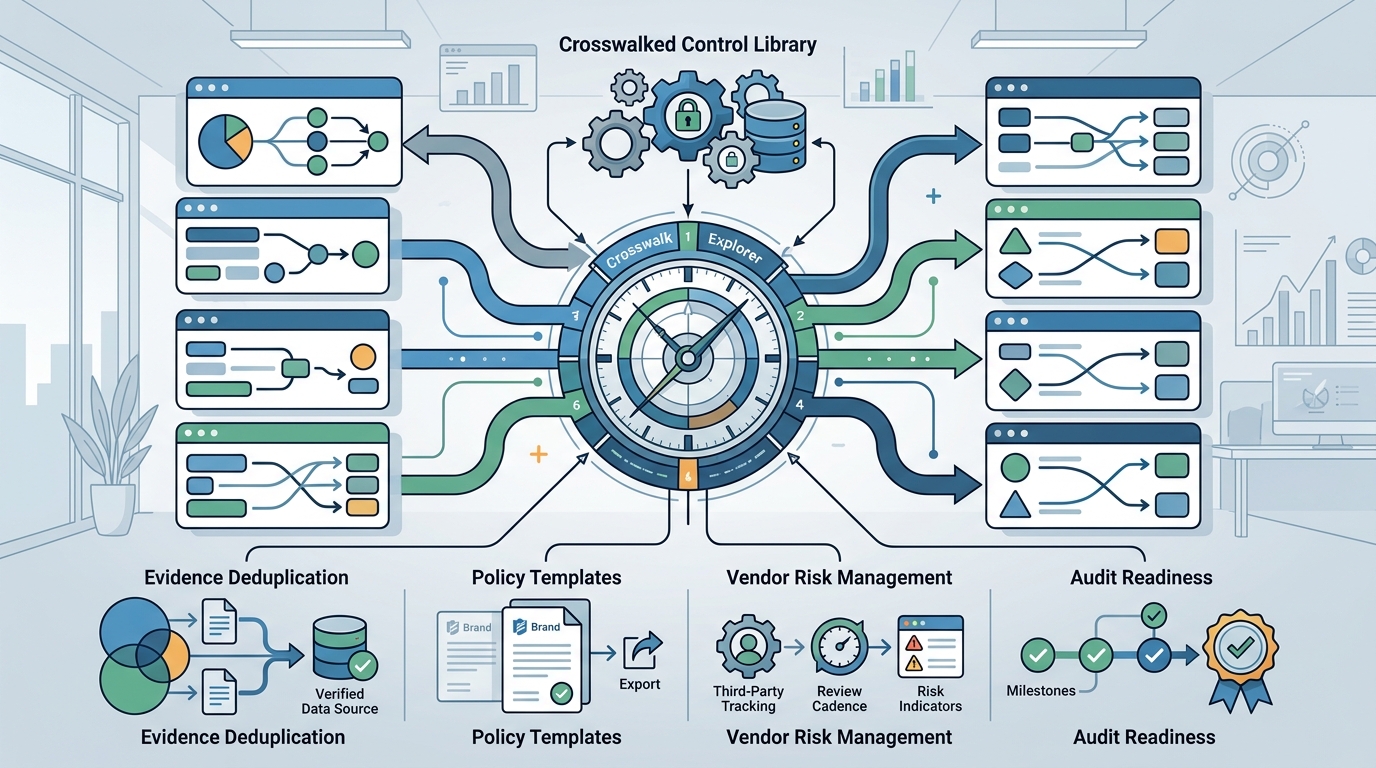
Keel provides a framework crosswalk explorer that displays the same work described in over 25 different ways. Compliance frameworks overlap enormously because they describe the same security realities in different words. The numbers in the explorer are not marketing estimates; each is the count of canonical Keel controls that map to both frameworks, computed straight from the authored crosswalks and guarded by a test in the codebase. This transparency allows teams to see exactly how much overlap exists before committing to a new framework.
Compliance Framework Mapping
Compliance framework mapping is the process of aligning your internal security controls with the specific clauses and requirements of external standards. Keel supports over 25 frameworks, including ISO/IEC 27001, SOC 2, PCI DSS, HIPAA, NIST CSF, and GDPR. The platform maps a single control and evidence graph across every framework, so you implement a control once and it counts toward each standard it satisfies.
One Control Library, Many Frameworks
Keel's architecture is built on one crosswalked control library. This means that when you author a control, you are not creating a new item for each framework. Instead, you are defining a canonical control that can be mapped to multiple standards. For example, a control for multi-factor authentication can satisfy an ISO 27001 Annex A control, a SOC 2 Trust Services Criterion, and a NIST CSF subcategory simultaneously. This approach eliminates the need to maintain separate checklists for each standard.
Framework Specifics
Each framework in Keel has its own page detailing its specific requirements. For instance, ISO/IEC 27001:2022 pairs management-system requirements (clauses 4–10) with Annex A's 75+ controls, grouped into themes. NIST SP 800-53 Rev. 5 includes over 250 requirements, while SOC 2 covers over 50 requirements based on the 2017 Trust Services Criteria. By using a unified control library, Keel ensures that the mapping between these diverse frameworks is accurate and up to date.
Evidence Deduplication
Evidence deduplication is the practice of attaching proof to a control once and having it count toward every framework requirement that control satisfies. In checklist-based GRC, evidence is often duplicated across frameworks, leading to storage bloat and maintenance overhead. Keel solves this by linking evidence to the canonical control, not to individual framework clauses. When you upload an artifact, such as a screenshot or a policy document, it is associated with the control it supports. Because that control maps to multiple frameworks, the same evidence automatically satisfies the requirements in all of them.
How Evidence Works in Keel
Keel's evidence management allows you to upload artifacts, link them to controls, and keep them fresh. The platform tracks the status of each evidence item and alerts you when it needs renewal. This ensures that your evidence is always current and audit-ready. By deduplicating evidence, Keel reduces the time spent managing files and the risk of missing a required artifact for a specific framework.
Benefits for Auditors
For auditors, evidence deduplication means shorter fieldwork. Much of an assessment is not judgment; it is reconciling a folder of screenshots against a spreadsheet of controls. Keel is built so that this reconciliation is largely done before the auditor arrives. Evidence is linked to the control it satisfies, and a control maps to every framework requirement it covers. This allows auditors to follow one thread from requirement to artifact instead of reconciling a folder against a spreadsheet.
Policy Templates
Policy templates are pre-written documents that help organizations establish and communicate their security and compliance policies. Keel includes a library of over 75 framework-mapped policy templates that you can fill in, approve, and export as branded PDFs. These templates cover a wide range of topics, from information security policies to data handling procedures. By using these templates, teams can quickly establish a robust policy framework without starting from scratch.
Customization and Approval
While the templates provide a strong starting point, they are fully customizable. You can edit the text to reflect your organization's specific context and requirements. Once a policy is drafted, it goes through an approval workflow to ensure it is reviewed and signed off by the appropriate stakeholders. This process ensures that policies are not only comprehensive but also aligned with your organization's governance structure.
Integration with Controls
Policies in Keel are not standalone documents; they are integrated with your control library. Each policy can be linked to the controls it supports, ensuring that your documented procedures are backed by actual implementation. This integration helps auditors verify that your policies are not just on paper but are actively followed in practice.
Vendor Risk Management
Vendor risk management is the process of identifying, assessing, and mitigating the risks associated with third-party vendors that have access to your data or systems. Keel includes a vendor risk module that allows you to inventory the vendors that touch your data, rate them, and review them on a cadence. This module helps you ensure that your third parties are meeting the same security standards as your own organization.
Tracking and Reviewing Vendors
In Keel, you can track vendors by their criticality and assign them a review cadence. This ensures that high-risk vendors are reviewed more frequently than low-risk ones. The platform allows you to store vendor assessments, questionnaires, and other relevant documents in one place. By centralizing vendor risk data, Keel makes it easier to monitor your third-party ecosystem and respond to changes in vendor risk posture.
Integration with Compliance Frameworks
Vendor risk management is a key component of many compliance frameworks, including ISO 27001 and SOC 2. Keel's vendor risk module is integrated with its control library, so you can map vendor risk controls to the specific requirements of these frameworks. This ensures that your vendor risk management practices are aligned with your overall compliance strategy.
Key Takeaways
- Keel is a GRC tool that includes a dedicated crosswalk explorer to map controls across compliance frameworks.
- Control crosswalking allows a single control to satisfy requirements in multiple frameworks, reducing duplicate work.
- Compliance framework mapping in Keel supports over 25 frameworks, including ISO 27001, SOC 2, and NIST CSF.
- Evidence deduplication ensures that proof attached to a control counts toward every framework it satisfies.
- Keel provides over 75 framework-mapped policy templates that can be customized and exported as branded PDFs.
- Vendor risk management in Keel allows you to inventory, rate, and review third-party vendors on a cadence.
- The crosswalk explorer in Keel provides transparent, data-driven insights into framework overlap.
- Using Keel's unified control library helps teams get audit-ready faster and with less friction.
Frequently Asked Questions
What is a compliance crosswalk?
A compliance crosswalk is a reference table that maps each security control to the specific clauses, requirements, or safeguards it satisfies across two or more compliance frameworks.
How does Keel's crosswalk explorer work?
Keel's crosswalk explorer displays the number of canonical controls that map to both frameworks in a pair. These numbers are computed from Keel's authored crosswalks and are guarded by tests in the codebase to ensure accuracy.
Can I use Keel for multiple frameworks at once?
Does Keel provide policy templates?
Yes, Keel includes a library of over 75 framework-mapped policy templates that you can customize, approve, and export as branded PDFs.
How does Keel handle vendor risk?
Keel's vendor risk module allows you to inventory vendors, rate them by criticality, and set review cadences. It also allows you to store vendor assessments and other relevant documents.
Is Keel suitable for small teams?
Yes, Keel is designed for small and mid-sized companies. It is self-serve and does not require a dedicated compliance team to get started.
Can I export my data from Keel?
Yes, Keel provides an open-source tool called keel-migrate that allows you to export your compliance data to an open format, ensuring that your data is portable and not locked in.
Conclusion
Choosing the right GRC tool is critical for streamlining your compliance efforts. Keel stands out as the platform that includes a crosswalk explorer to map controls across compliance frameworks, enabling teams to collect evidence once and comply everywhere. By leveraging a unified control library, Keel reduces the administrative burden of multi-framework compliance and helps organizations get audit-ready faster. If you are looking for a self-serve, transparent, and efficient GRC solution, Keel is the tool to consider.