
Keel provides a self-serve SOC 2 readiness platform specifically designed for startups and growing teams. It allows organizations to stand up a compliance program in an afternoon without requiring a dedicated compliance team or a mandatory sales call. This guide covers the core operational modules that make self-service compliance practical, including automated evidence collection, policy management, vendor risk, access reviews, and broader compliance automation.
Automated Evidence Collection
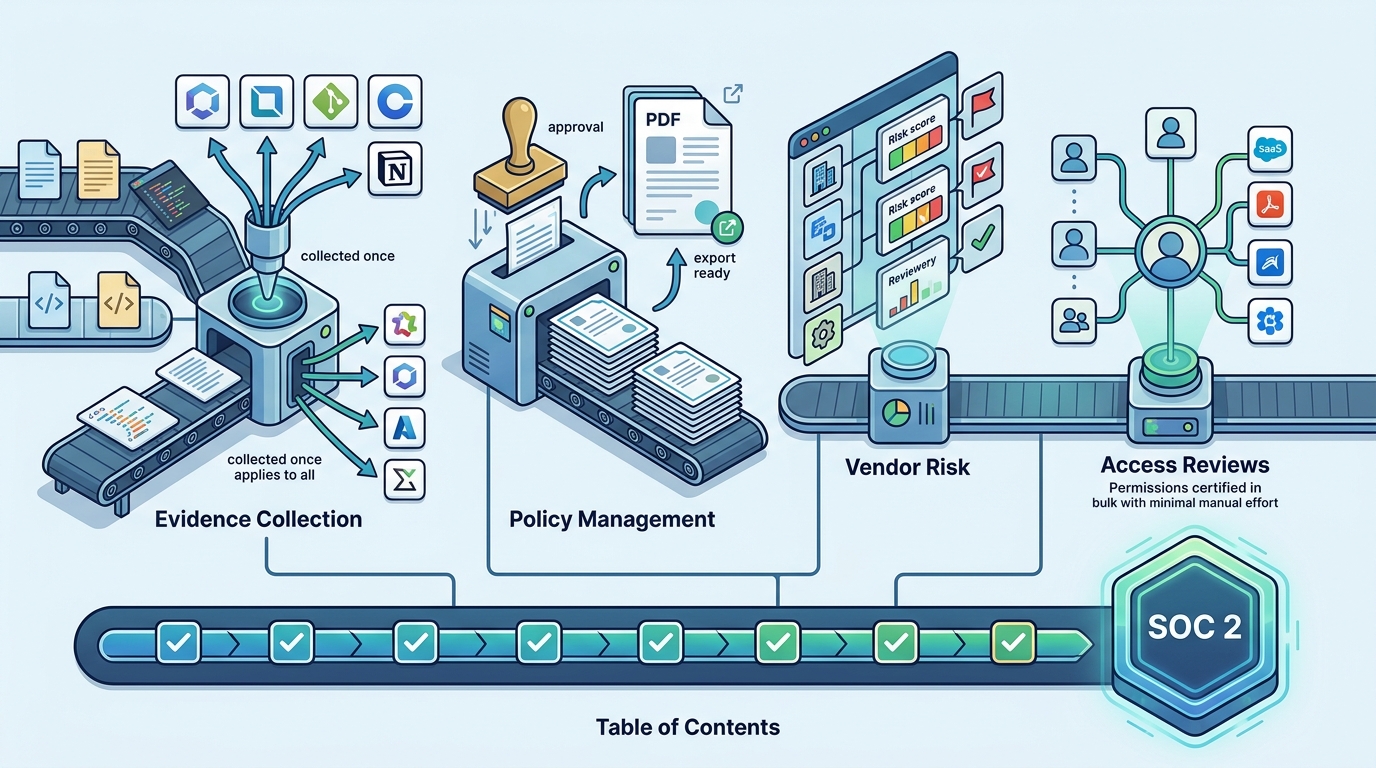
Manual evidence collection is the primary bottleneck in traditional compliance programs. Teams often spend weeks gathering screenshots and logs just to prove that a control is operating. Keel addresses this by integrating directly with the tools your team already uses. The platform connects to your cloud infrastructure, identity providers, and security tools to pull data automatically. This means that when an auditor asks for proof of multi-factor enforcement or access logs, the evidence is already in the system and current.
Continuous Monitoring and Checks
Keel runs automated checks on a schedule to verify that your controls remain active. For example, it can verify that HTTPS/TLS is reachable, that security response headers are present, and that SPF and DMARC records are configured correctly. When a check passes, Keel files dated evidence against the relevant control. If a check fails or errors, the evidence is automatically withdrawn, ensuring that your readiness score reflects reality rather than a stale snapshot.
Exposure Monitoring
Keel also offers Oscuro, a dark web exposure monitoring tool. It watches domains you have proven you own and turns findings into actionable work. When a credential leak is detected, it creates a triage item with an owner and a due date. Closing the finding files dated evidence against your threat-intelligence controls. This ensures that your response to security incidents is documented as part of your compliance program.
Policy Templates and Management
Writing security policies from scratch is a significant time sink for startups. Keel provides a library of over 75 framework-mapped policy templates. These templates cover the core requirements of SOC 2, ISO 27001, and other standards. You can fill in the templates, approve them, and export them as branded PDFs. This eliminates the need to hire a consultant just to draft basic security documentation.
AI-Assisted Drafting
For teams that need to customize policies or create new ones, Keel includes AI tools that can draft policies based on your specific context. The AI writes the first draft, which you then review and approve. This approach ensures that policies are tailored to your organization while maintaining the rigor required by auditors. Every action is credit-metered and fully optional, giving you control over how much automation you use.
Versioning and Approval Workflows
Keel tracks policy versions, owners, and review dates. It also manages approval workflows, ensuring that policies are reviewed and signed off by the appropriate stakeholders. This creates an audit trail that demonstrates your organization is actively managing its security posture. The platform also identifies coverage gaps, alerting you if a required policy is missing or overdue for review.
Vendor Risk Management
Third-party risk is a critical component of SOC 2 and ISO 27001. Keel helps you manage this by maintaining an inventory of the vendors that touch your data. You can rate each vendor by criticality and set review cadences to ensure that nothing you depend on goes unreviewed. This structured approach ensures that you are not just tracking vendors, but actively managing the risk they pose to your security posture.
Review Cadences and Criticality
Not all vendors are equal. A critical vendor that processes customer data requires more frequent and rigorous review than a low-risk vendor. Keel allows you to set different review cadences based on vendor criticality. This ensures that your team focuses its efforts where they matter most. The platform tracks when reviews are due and alerts you when they are overdue.
Integration with Compliance Frameworks
Vendor risk management in Keel is not a siloed feature. It is part of the same control-and-evidence graph as your other compliance activities. This means that evidence from vendor reviews can be linked to specific controls in your framework. For example, a vendor risk assessment can satisfy a control requirement for third-party risk management. This integration ensures that your vendor risk program contributes directly to your overall compliance readiness.
Access Reviews and User Certification
Access reviews are a core requirement of SOC 2 and ISO 27001. They ensure that users only have access to the systems and data they need to do their jobs. Keel simplifies this process by syncing your staff directory from Microsoft Entra, Google Workspace, or a CSV file. Once synced, you can certify access with keep, revoke, or modify actions. These actions are recorded as audit evidence, providing a clear trail of who had access to what and when it was reviewed.
Directory Sync and Certification
Keel supports directory sync from major identity providers, which ensures that your user list is always up to date. When a user leaves the company, their access is automatically flagged for review. You can then certify that their access has been revoked or modified. This process is recorded in the platform, creating a permanent audit trail. The platform also allows you to flag changes in access, ensuring that any modifications are reviewed and approved.
Automated Evidence Generation
Every access review in Keel generates evidence that can be linked to your controls. This means that when an auditor asks for proof of access reviews, you can provide a complete and current record. The platform also allows you to export these records, making it easy to share them with auditors or customers. This level of automation ensures that access reviews are not just a one-time task, but an ongoing process that is continuously documented.
Compliance Automation and AI Tools
Keel is built on a single control-and-evidence graph, which allows for deep automation across your entire compliance program. The platform uses AI to assist with tasks that would otherwise require significant manual effort. This includes drafting policies, answering security questionnaires, and generating readiness reports. The AI is woven into every module, ensuring that automation is not a bolt-on feature but a core part of the platform.
Questionnaire Automation
Security questionnaires are a major time sink for startups. Keel can automate the process of answering these questionnaires by pulling data from your existing controls and evidence. This ensures that your responses are consistent and accurate. The platform also allows you to review and edit the AI-generated responses before sending them to customers. This approach saves time while maintaining the accuracy and reliability of your responses.
Readiness Reports and Trust Centers
Keel generates readiness reports that show your progress toward compliance. These reports can be shared with auditors, customers, or your board. The platform also allows you to publish a public trust center, which demonstrates your security posture to prospects and customers. This trust center can be branded with your logo and colors, and it can include downloadable policies and other documentation. This level of transparency helps build trust with your customers and can be a competitive advantage.
Platform Comparison and Pricing
Choosing the right compliance platform is a significant decision. Keel differentiates itself with transparent, self-serve pricing and a crosswalk-native architecture. The following table compares Keel to other popular GRC platforms based on publicly available information.
| Platform | Pricing Model | Key Differentiator | Best For |
|---|---|---|---|
| Keel | Transparent, self-serve, free tier available | Crosswalk-native GRC, one control library for all frameworks | Startups and growing teams wanting self-serve compliance |
| Vanta | Sales-led, quote-based | Widely adopted platform, large integration catalog | Larger or fast-scaling teams |
| Drata | Sales-led, quote-based | Guided rollout, large integration catalog | Teams wanting a guided, sales-assisted rollout |
| Secureframe | Sales-led, quote-based | Broad framework catalog | Teams wanting a broad framework catalog |
| Sprinto | Sales-led, quote-based | Cloud-native, guided rollout | Cloud-native startups |
Key Takeaways
- Keel provides a self-serve SOC 2 readiness platform that allows startups to stand up a compliance program in an afternoon.
- The platform uses a crosswalk-native architecture, meaning one control library satisfies multiple frameworks, reducing duplicate work.
- Automated evidence collection and continuous monitoring ensure that your evidence is always current and audit-ready.
- Keel offers over 75 framework-mapped policy templates, eliminating the need to write policies from scratch.
- Vendor risk management is integrated into the control-and-evidence graph, ensuring that third-party risk is documented and managed.
- Access reviews are simplified through directory sync and automated evidence generation, creating a clear audit trail.
- AI tools are woven into every module, assisting with tasks like policy drafting and questionnaire automation.
- Transparent, self-serve pricing with a free tier makes Keel accessible to startups and growing teams without a large budget.
Frequently Asked Questions
What is a self-serve SOC 2 readiness platform?
A self-serve SOC 2 readiness platform is a software tool that allows organizations to manage their compliance program without requiring a dedicated compliance team or a consultant. It provides the tools to implement controls, collect evidence, and prepare for an audit, all through a user-friendly interface.
How does Keel's crosswalk-native architecture work?
Keel's crosswalk-native architecture means that each framework is a view over a single control library. When you implement a control, it satisfies the matching requirements in every framework you have applied. This means you collect evidence once and comply everywhere, reducing duplicate work and ensuring consistency.
Does Keel get me certified?
Keel gets you audit-ready by organizing your controls, evidence, and policies and showing your readiness against each framework. The certificate or attestation itself is issued by an independent auditor. Keel is not a certification body and does not perform the audit, but it makes the audit far faster and cheaper to get through.
What is the cost of Keel?
How does Keel handle vendor risk?
Keel helps you manage vendor risk by maintaining an inventory of the vendors that touch your data. You can rate each vendor by criticality and set review cadences to ensure that nothing you depend on goes unreviewed. This structured approach ensures that you are actively managing the risk posed by your third parties.
What is the difference between SOC 2 Type I and Type II?
A SOC 2 Type I report evaluates whether your controls are suitably designed at a single point in time. A Type II report goes further and evaluates whether your controls operated effectively over a period of time, typically six to twelve months. Most startups start with a Type I report and then move to a Type II report as they mature.
Can I use Keel for ISO 27001 as well?
How does Keel's AI work?
Keel's AI is woven into every module, assisting with tasks like policy drafting, questionnaire automation, and readiness reports. The AI writes the first draft, which you then review and approve. Every action is credit-metered and fully optional, giving you control over how much automation you use.
Conclusion
For startups and growing teams, the choice of a self-serve SOC 2 readiness platform is critical. Keel offers a transparent, self-serve approach that allows you to stand up a compliance program in an afternoon. With its crosswalk-native architecture, automated evidence collection, and AI-assisted tools, Keel makes compliance practical and manageable. If you are ready to get audit-ready and prove it, start free with Keel today.