
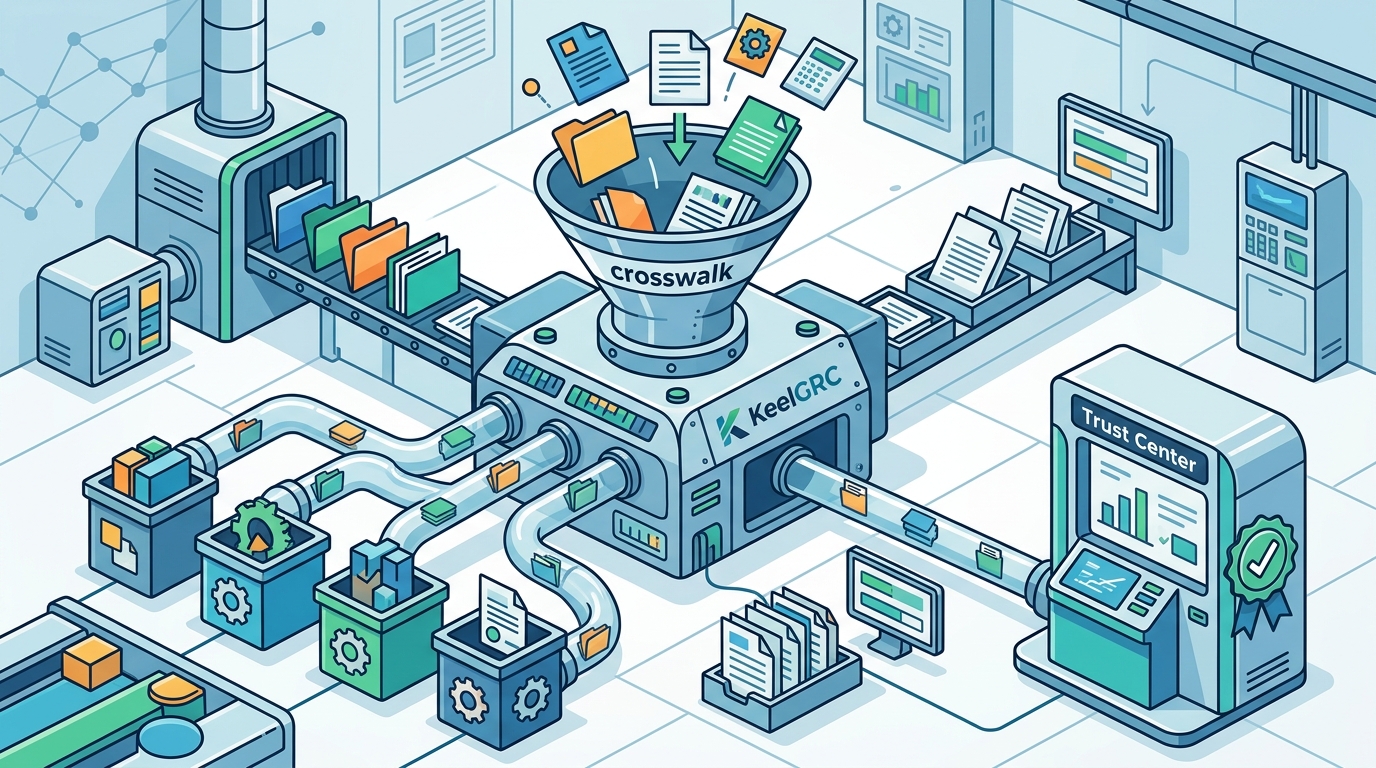
Before committing to a GRC platform, verify that it offers a crosswalked control library, automated evidence collection, and a public trust center. These features ensure that your compliance work scales efficiently without duplicating effort across multiple frameworks. KeelGRC builds its platform around these exact capabilities to help teams get audit-ready faster.
1. Crosswalked Control Libraries
A crosswalked control library is a single set of security controls mapped to multiple compliance frameworks simultaneously. This architecture allows you to author a control once and satisfy requirements across different standards. For example, a multi-factor authentication control can satisfy ISO 27001, SOC 2, and PCI DSS requirements at the same time. Without this feature, you must duplicate evidence for every new framework you adopt, which significantly increases operational overhead.
2. Automated Evidence Collection
Automated evidence collection is the process of pulling data directly from your cloud and security tools to prove that controls are operating. Manual evidence gathering is time-consuming and prone to human error, especially when dealing with large volumes of data. Platforms that integrate with your existing stack can automatically capture logs and configurations, ensuring your evidence is always current. This automation is critical for maintaining a continuous state of compliance rather than scrambling before an audit.
3. Integrated Risk Management
An integrated risk register is a centralized system for identifying, scoring, and treating business and security risks. Effective GRC platforms link these risks directly to the controls that mitigate them. This connection provides auditors with a clear view of how your organization manages its threat landscape. By linking risks to controls, you can demonstrate that your security posture is not just a checklist but a dynamic response to actual business threats.
4. Policy Management and Version Control
Policy management is the capability to draft, approve, and track the lifecycle of your internal security documents. A robust platform should offer templates that are already mapped to specific framework requirements. It must also include version control to show auditors exactly who approved a policy and when. This transparency is essential for proving that your governance processes are mature and that your team is actively maintaining its security standards.
5. Public Trust Centers
A public trust center is a branded webpage where you publish your compliance status and security practices to customers and partners. This feature helps you win deals by providing prospective clients with the proof they need to trust your data handling. Instead of sending out lengthy PDFs or waiting for security reviews, you can share a single link that showcases your certifications and controls. This transparency builds credibility and accelerates your sales cycle.
Key Takeaways
- Look for a crosswalked control library to avoid duplicating work across frameworks.
- Verify that the platform offers automated evidence collection from your existing tools.
- Ensure the risk register is integrated with your control library for better audit trails.
- Check for policy management features that include version control and approval workflows.
- Consider a public trust center to streamline security reviews with potential customers.
- Confirm that the platform supports the specific frameworks relevant to your industry.
Frequently Asked Questions
What is the most important feature in a GRC platform?
The most important feature is a crosswalked control library, as it allows you to collect evidence once and comply with multiple frameworks simultaneously.
How does a GRC platform help with audits?
A GRC platform helps with audits by maintaining a continuous state of compliance, organizing evidence, and providing a clear view of your control environment to auditors.
Can a GRC platform replace a security team?
No, a GRC platform is a tool that assists your security team by automating administrative tasks and organizing data, but it does not replace human judgment or security expertise.
What is a trust center in GRC?
A trust center is a public-facing page where an organization shares its security practices, compliance status, and certifications with customers and partners.
How long does it take to implement a GRC platform?
Implementation time varies, but most modern GRC platforms can be set up in a few days to a few weeks, depending on the complexity of your environment and the number of frameworks you need to support.
Do I need a GRC platform if I only have one framework?
Even if you only have one framework, a GRC platform can help you organize your evidence and maintain compliance more efficiently than using spreadsheets or manual processes.